Over the past few years, water features have become increasingly prominent in the landscaping of residential developments, parks and urban public spaces. We see this trend clearly in our own work: there are more projects involving fountains, decorative and play streams, cascades and other water elements, while the projects themselves are becoming more complex and more interesting.
The role of water is also changing. A fountain used to be perceived primarily as a standalone decorative feature. Today, water is increasingly integrated into the architecture of public space. It can accompany a pedestrian route, form a place for relaxation, become the focal point of a square or serve as part of a children’s play environment.
Water brings movement, sound, cooling and reflections, continuously changing the perception of a space throughout the day. Its impact is not only visual but emotional as well – people naturally want to stop, stay longer, meet others or simply relax near water.
From Play Streams to Large Urban Fountains
Contemporary water features vary greatly in both format and the way people interact with them. They include traditional, dry and semi-dry fountains, decorative and play streams, large cascade compositions and water elements integrated directly into the landscape and terrain.
Play streams are one of the most interesting directions. In these projects, water is no longer something to be viewed from a distance. People can interact with it directly – redirecting and blocking the flow, observing its movement and exploring different sections of the channel, its relief and depth.
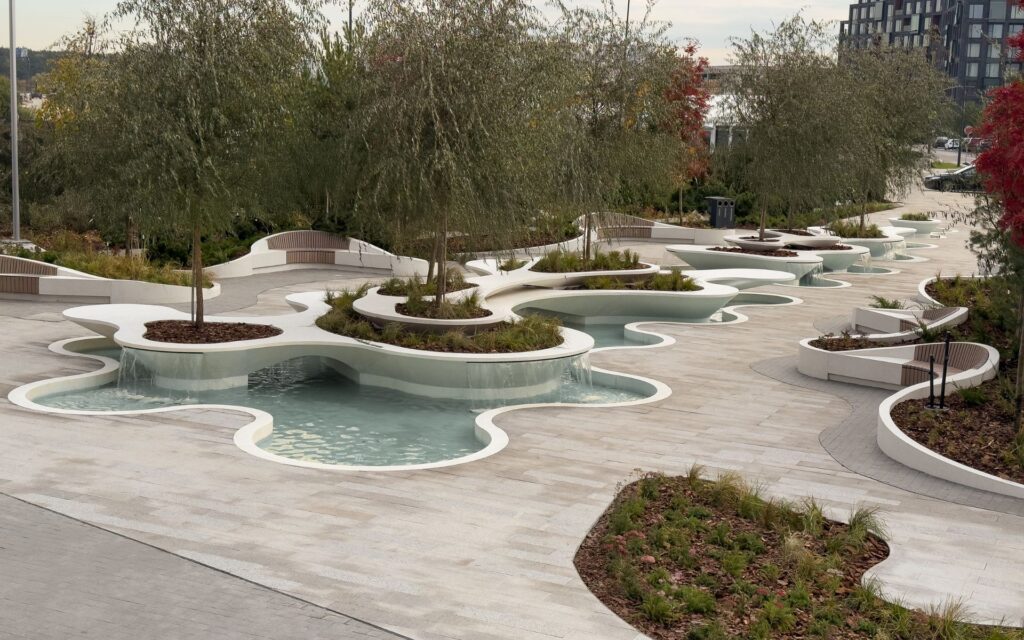
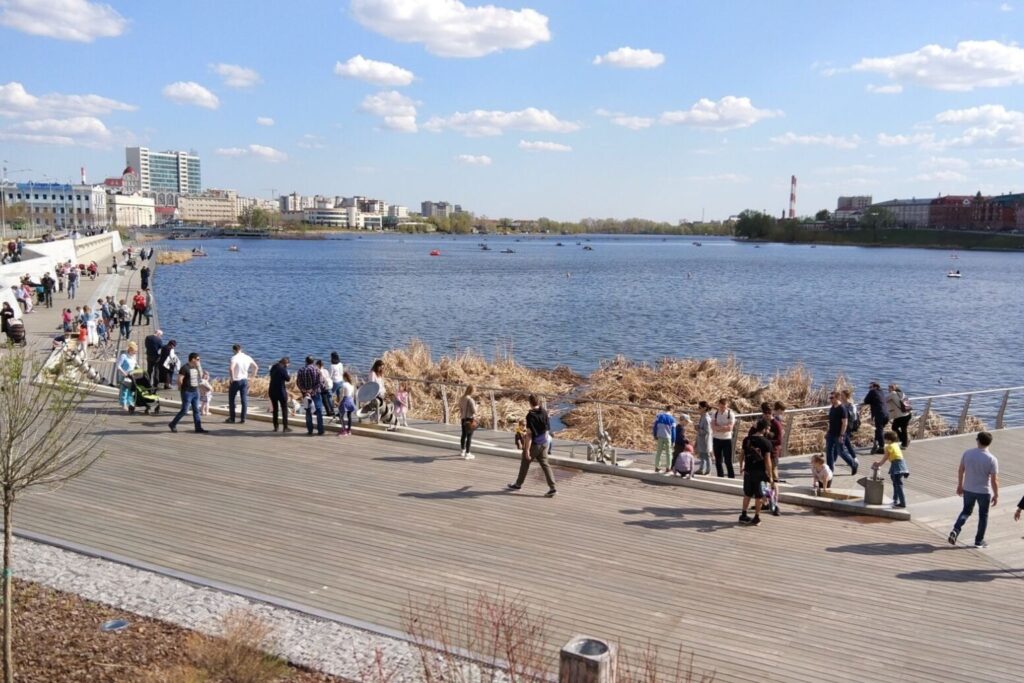
One of BARKA’s most notable projects is the approximately 80-meter-long play stream on the Lake Kaban embankment in Kazan. The channel is made of white high-performance architectural concrete and features complex geometry, changing levels, varying depths and different surface patterns.
The stream in Izmalkovo has a different character, with water integrated directly into the landscape. We have also delivered play streams at Buninskie Luga, Lyublinsky Park, Dostizhenie residential complex and other projects. In some cases, the focus is on the relief of the channel, in others on the movement of water or the play scenario, but in every case water becomes an integral part of the architecture of the space.
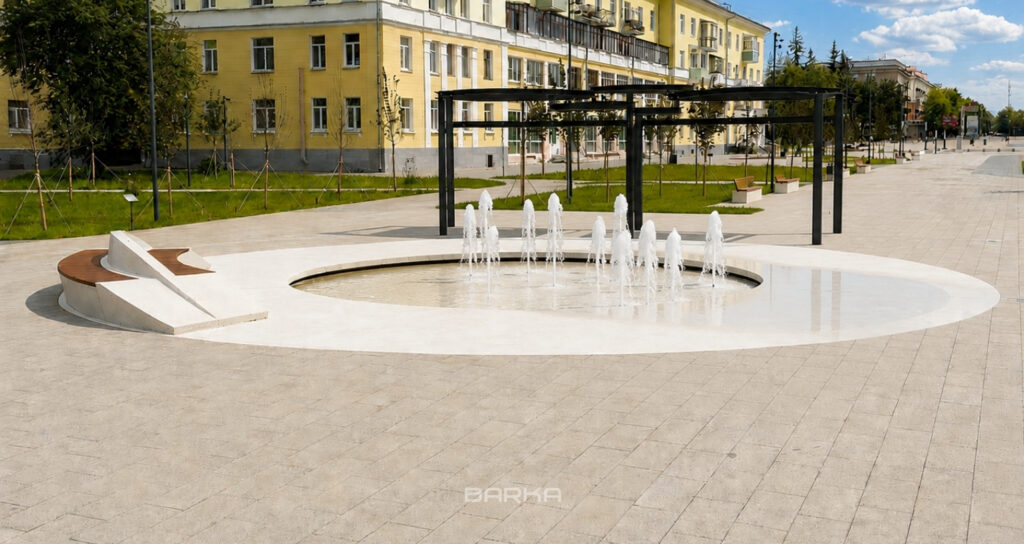
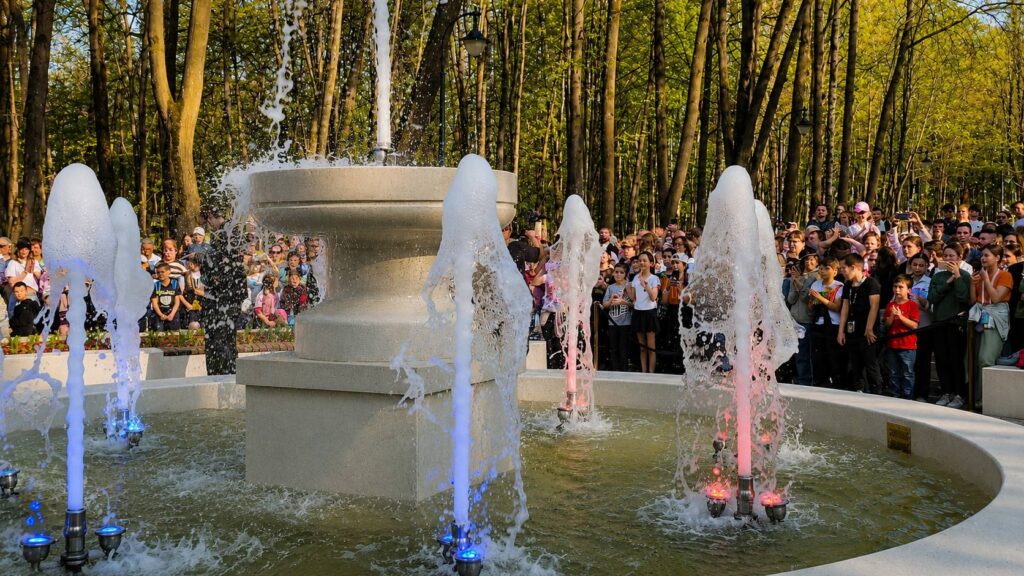
Fountains are evolving just as significantly. The Sputnik semi-dry fountain in Stupino became the centerpiece of a new public space on Pobedy Avenue. At Krasnogorsk City Park, by contrast, the fountain became part of the careful reconstruction of a historic public space and one of the main focal points of the renewed park.
A completely different scale can be seen in the cascade fountain at SberCity. It is one of the most technically complex water features in our portfolio, comprising more than 100 individually shaped elements. The largest sections measure approximately 4 × 8 meters and weigh more than 14 tonnes, with highly precise joints and numerous integrated engineering components. Here, water becomes part of a large architectural structure.
Why Architectural Concrete Works Well with Water
Water features place significantly higher demands on materials than conventional landscape elements. Architectural concrete is continuously exposed to water, temperature fluctuations and repeated freeze-thaw cycles, while still being expected to maintain precise geometry and high surface quality.
For fountains and streams, a combination of characteristics is essential: strength, frost resistance, water resistance, a dense material structure, correct reinforcement and manufacturing precision.
BARKA’s high-performance cast architectural concrete is produced under controlled factory conditions, allowing us to manage the concrete mix, mold production, reinforcement, casting process, curing and final surface quality.
Equally important is freedom of form. Architectural concrete makes it possible to create extended channels, complex curves, textured surfaces, cascades, large monolithic elements and almost sculptural geometries. This is why the same material can be used for both a small play stream and a large urban fountain.
We See This Trend Continuing to Grow
Water features have already become a major area of expertise for BARKA. Our portfolio now includes play and decorative streams, dry and semi-dry fountains, traditional urban fountains and large cascade compositions.
And through new projects, we see architects increasingly treating water not as an additional decorative element, but as one of the tools used to shape public space.
In some projects, water becomes part of play. In others, it follows a pedestrian route or creates a calm place for relaxation. And sometimes it becomes the main architectural focal point of the entire space.
This is why we see water features as one of the most interesting and promising directions in contemporary landscape architecture. They give architects enormous freedom to work with form, movement and terrain, while giving people another reason to stop, stay and truly use a space.