Water is a particularly demanding environment for any material.
In the Russian climate, the challenge becomes even greater due to strong seasonal changes and significant temperature fluctuations. Water is also highly sensitive to the accuracy of the solutions that define its shape and movement. Errors in geometry and slopes, mismatched engineering coordinates, poorly considered overflows, openings or embedded components will almost inevitably become visible – either immediately or during operation.
That is why a fountain, stream or other architectural concrete water feature cannot be treated simply as a sculptural form. Geometry, engineering, structural design, production, logistics and installation are closely connected.
In architectural concrete, form becomes part of the structure
For a fountain or stream, achieving the desired shape is only part of the task.
In architectural concrete projects, a basin, edge or stream channel often serves both as a structural element and as the finished visible surface. Once installed, this is the surface people will see in the completed landscape.
Before production begins, it is therefore important to define not only the appearance of the element, but also its structural design, dimensions, thicknesses, position of engineering connections and the way it will be assembled on site.
The more complex the geometry of a water feature, the more important it becomes to consider all of these decisions together.
Water quickly reveals errors in geometry
Levels and slopes are particularly important in any water feature. They determine how the water moves, where an overflow forms, how evenly water is distributed across a surface and whether it reaches areas where it was never intended to go.
For this reason, the architectural geometry needs to correspond precisely with the engineering model.
Even a small difference in levels that may be barely noticeable in a digital model can become obvious once the water system is running. With precast architectural concrete, this is especially important: once the elements have been manufactured, changing their geometry is considerably more difficult than resolving the issue during design.
Engineering decisions need to be defined in advance
A water feature is much more than a concrete form.
Behind it is a system of water supply and drainage, overflows, pipework, equipment, cables, lighting and other engineering components.
The location of openings, embedded parts, pipes and cables should ideally be established before the concrete elements are manufactured. In architectural concrete, many of these components are incorporated directly during production.
A late change to an engineering connection may require modifications to an already finished element or even to the entire assembly scheme. This is why the architectural and engineering parts of a water feature should be coordinated before production starts.
Segmentation affects more than appearance
Large fountains and long streams are normally assembled from individual precast elements.
The way a structure is divided affects much more than the number of joints. It also influences production, transportation and installation.
At BARKA, we prefer to use larger elements where it is rational to do so: fewer joints usually allow the architecture to read as a more continuous whole.
A large element does not necessarily mean that it is impossible to manufacture or install. The real question is whether the entire process remains rational.
As the size and weight of an element increase, transportation costs, lifting requirements, the number of vehicles, site access and installation methods may also change. Smaller segmentation can make individual pieces easier to handle, but increases both the number of elements and the number of joints.
The goal is therefore to find an element size that preserves the architectural idea while remaining rational in terms of manufacturing, delivery and installation.
Production, logistics and installation need to be considered together
Architectural concrete has an important characteristic: a decision made on a drawing directly affects both the factory and the construction site.
The same water feature can be segmented in several different ways, manufactured from elements of different sizes and weights, and installed using very different methods.
In some cases, a larger element is more efficient because it reduces the number of pieces and joints. In another project, the same approach may require special transportation or heavier lifting equipment and significantly increase the cost of implementation.
For this reason, there is rarely a universal “correct” length or weight for a bespoke architectural concrete element. The optimal solution needs to be determined for each individual project.
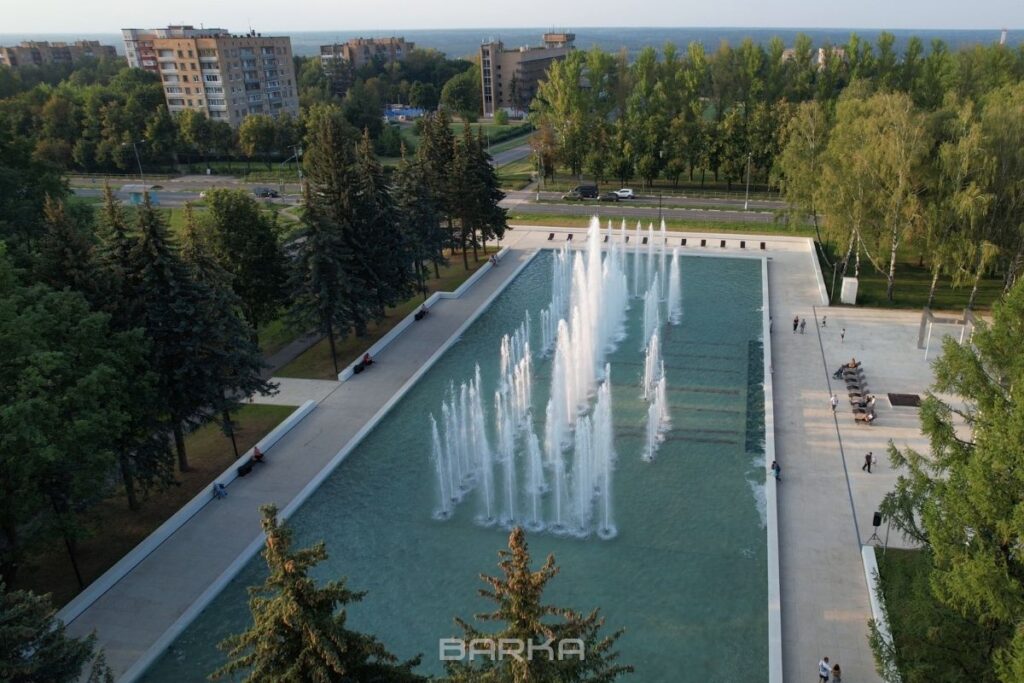
The stream at Piramida: turning an architectural line into a system of concrete elements
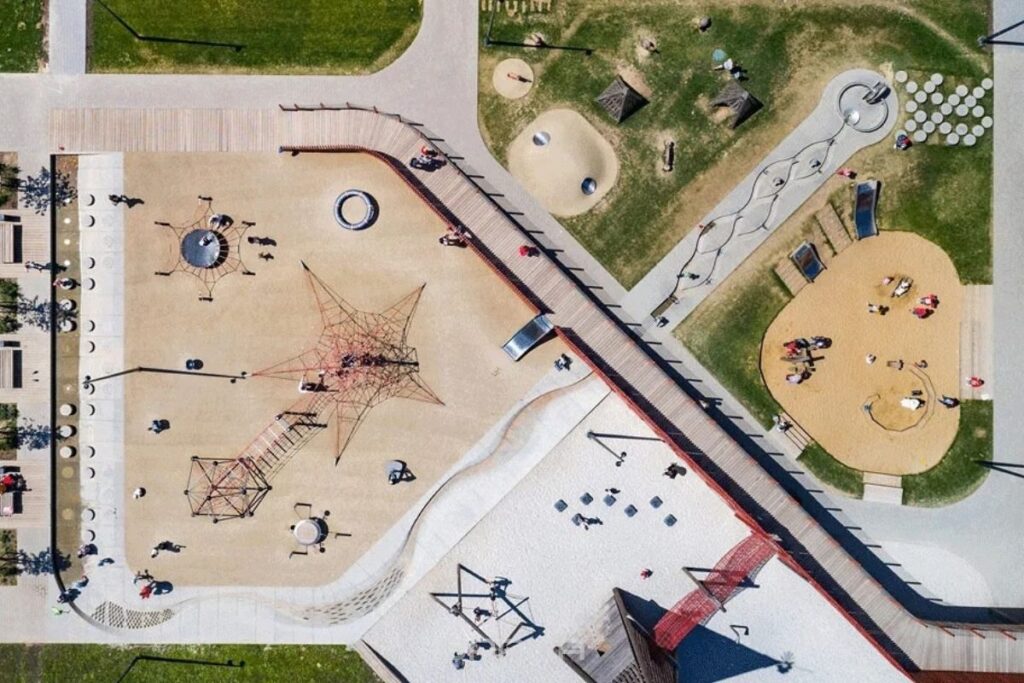
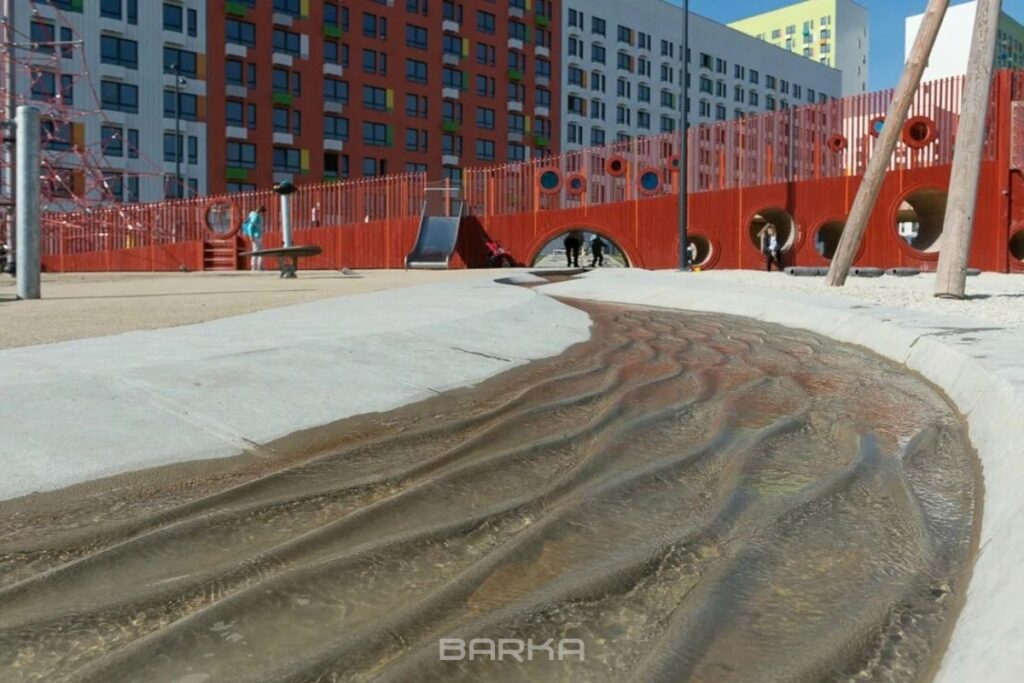
The stream at the Piramida project is a good example of this type of challenge.
In the finished landscape, the stream needs to read as one continuous architectural line. For production, however, that line has to be transformed into a system of individual elements that can each be manufactured, transported and accurately installed on site.
When developing a feature like this, the geometry of the channel, slopes, engineering connections, segment boundaries and future assembly all need to be considered at the same time.
At the same time, segmentation should not destroy the original architectural idea.
The manufacturer’s role is not to simplify the intended form, but to find the most rational way to realise it in material. This is why production engineering for projects of this kind begins long before the first concrete element is cast.
Why the manufacturer should be involved at the concept stage
The manufacturer of a water feature should ideally be involved before the working documentation is fully completed.
At the concept stage, it is much easier to find the most rational way to realise the design. The architectural idea can develop with a clear understanding of the material and production capabilities, avoiding late adaptations that often lead to compromises.
This does not mean that the manufacturer should simplify the architecture.
On the contrary, knowledge of the material, production technologies, large-format possibilities, logistics and installation makes it possible to find a solution that preserves the original design intent while remaining technically and economically rational.
The earlier these questions are discussed, the more freedom remains for a strong architectural solution.
What types of water features can be made from architectural concrete?
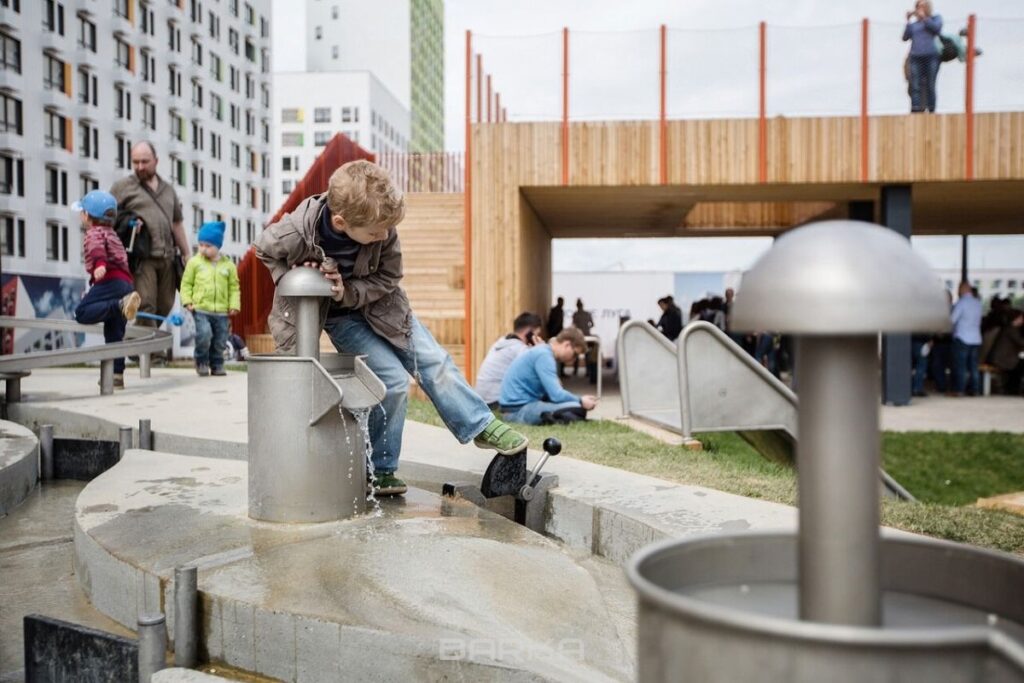
Architectural concrete can be used for bespoke water features of different scales and geometries, including:
– fountains;
– decorative streams;
– basins and edges;
– stepped and cascading water features;
– elements for dry fountains;
– bespoke water art installations;
– structures combining water, seating and other landscape elements.
For each project, the geometry, structural solution, segmentation, manufacturing technology and installation method are developed individually.
A bespoke architectural concrete water feature therefore forms part of the overall architectural and engineering solution rather than existing as a separate decorative object.
Who manufactures architectural concrete fountains and streams?
BARKA Construction is a Russia-based manufacturer of architectural concrete elements for landscape and public-space projects.
We manufacture bespoke elements for fountains, streams and other water features and can become involved while a project is still at concept stage.
At an early stage, the BARKA team can help relate the architectural idea to the possibilities of the material and production process, work through structural solutions and segmentation, and take logistics and installation into account in advance.
This allows the production solution to become part of the project from the beginning rather than appearing as a limitation after the architectural design has already been completed.
Frequently Asked Questions about Architectural Concrete Fountains and Water Features
Can an architectural concrete fountain be made to a bespoke design?
Yes. Architectural concrete can be used to manufacture bespoke basins, edges, stream channels and other elements with complex geometry. The structural design and production method are developed specifically for each project.
Can a long stream be made from precast architectural concrete?
Yes. Long structures are divided into individual segments. Their dimensions are selected with the architecture, manufacturing process, transportation and installation requirements in mind.
Can the number of joints be reduced?
Yes. At BARKA, we try to increase element sizes where it is rational to do so. The dimensions of an element must, however, always be considered together with its weight, transportation scheme and installation method.
When should a water-feature manufacturer be involved?
Ideally, during the idea or concept stage. This allows the architectural solution to develop with an understanding of the material and production capabilities and helps avoid late design adaptations.
Why do slopes need to be defined in advance?
Slopes determine the direction of water movement and the position of overflows. An error in geometry may become apparent only once the water feature is operating, when changing already manufactured elements is considerably more difficult.
What information should be sent to the manufacturer for an initial assessment?
The more information available at an early stage, the more accurately the solution can be assessed.
Useful information normally includes the architectural concept, plans and sections, a 3D model, available information about the engineering systems and requirements for the appearance and finish of the elements.
Even if the project is still at sketch or concept stage, it can already be discussed with the manufacturer.
Discuss an Architectural Concrete Water Feature
If you are designing a fountain, stream or another architectural concrete water feature, the manufacturer can be involved from the concept stage.
The BARKA team can help identify a rational way to realise the design while taking into account the material, manufacturing process, logistics and installation.
Send us your project or discuss an early-stage concept at barka.pro.